How to Advertise on Inmar in 2026
If you are trying to work out how Inmar advertising actually works, the public information runs out fast. Inmar powers retail media for somewhere between 25 and 30 grocery networks and publishes almost nothing a brand can act on. This is what I have been able to verify, and what I have learned running live campaigns inside the platform.
Inmar is a coupon clearinghouse that grew into a media company, not an ad-tech firm that grew into retail. That history shapes everything: the offer is the atomic unit of its media product in a way it is not at Criteo or Instacart. You cannot buy Inmar directly — there is no self-signup. You buy through each individual retailer whose network it powers.
Two things matter most before you spend anything. First, "Inmar" covers two very different businesses — a self-serve auction ad platform, and a managed shopper marketing operation selling circular features and promotional programmes. They have different products, different buying routes and wildly different entry costs. Most confusion about Inmar comes from treating them as one thing. Second, Inmar rarely owns every surface at a given retailer — at Northeast Grocery, Instacart powers onsite e-commerce ads while Inmar handles offers and offsite, meaning two vendors and two irreconcilable reports.
The self-serve platform is real, includes auction-based Sponsored Products, and is documented nowhere publicly. Section 4 describes what it actually looks like, including the thing that surprised me most: manual keyword targeting is not exclusive. Your keyword list raises bids on those terms; it does not stop your products showing against others. If you come from Amazon, that assumption will cost you money.
Inmar launched Multi-Retailer Creator Activation in May 2026, letting one creator strategy run across retailers with measurement down to retailer-level lift. It is the first product I have found where Inmar sells across networks rather than one at a time — and so far it is creator-only.
Its scale figures also multiplied, and they are easy to misread. The incentives page claims 240M+ verified shoppers and 38% ACV coverage of total US grocery. The brands page separately claims 200M+ targetable shoppers and 98% identification across the US population, with 80% household coverage. These describe different capabilities, not one addressable audience. Ask which denominator applies to the exact product you are buying.
| Inmar advertising | What brands need to know |
|---|---|
| Self-signup | No — retailer-side only. |
| Sponsored Products | Yes — self-serve, auction-based, on supported retailer networks. Undocumented publicly. |
| Display ads | Yes, in the same console. |
| Campaign types | Smart Shopping (platform controls placement and bids) or Search Only (you supply keywords). |
| Keyword targeting | Manual keywords are not exclusive — they raise bids, they do not contain spend. |
| Negative keywords | None that I have found on the networks I run. |
| Network targeting | One retailer banner per campaign. No combined buy across banners. |
| Pricing | Not publicly disclosed for the self-serve platform. Budgets set per campaign. |
| Billing | Prepaid wallet. Delivery stops when the balance runs out. |
| Retailers | 25–30 networks claimed, never published. Seven independently confirmed (section 2). |
| Cross-retailer campaigns | Creator activation only, since May 2026. No evidence of it for standard media. |
| Reporting | Ad revenue, ROAS, CTR, CPC and orders at SKU level, with export. |
| Attribution model | Not disclosed — no lookback window, view-versus-click rule or incrementality method published. |
| Best fit | Grocery and CPG brands with real distribution at a supported retailer, and a promotional strategy to build offers from. |
1. What Inmar actually is
Inmar's own FAQ puts it plainly: "Our business started more than 45 years ago with print coupons." The company was founded in 1980, is headquartered in Winston-Salem, North Carolina, and has been majority-owned by OMERS Private Equity since 2017.
That origin is the single most useful thing to understand. Inmar describes itself as operating a "retail clearinghouse" acting "as an intermediary between retailers and brands," and claims it is uniquely "both publisher and settlement provider, giving brands end-to-end control and a complete view of performance from distribution through redemption."
At Criteo or Instacart the atomic unit is an impression. At Inmar it is frequently an offer. The self-serve tool Wakefern launched is literally called "Offer Media" and auto-generates creative from the offer details. If your brand has no promotional strategy, you are using a fraction of what Inmar is built to do — and probably paying for the wrong platform.
The media arm was assembled by acquisition: Reach Influence in 2017, ownerIQ in 2019, and Aki Technologies in 2021, the last bringing moments-based predictive targeting.
The naming problem, which is a real diligence hazard
In April 2023 Inmar named its consolidated media division Aki Technologies. In January 2025 it retired that and introduced Inmar Media, folding those capabilities back under the Inmar name. Three names in three years.
As of 2026 the structure is: the corporate entity is Inmar, Inc.; the market-facing brand is Inmar Intelligence; the media offering is Inmar Media; the retailer technology stack is Inmar Retail Cloud; and the platform you will actually log into is Media Manager, authenticated by ShopperSync.
Inmar now also markets Inmar Activate, described as "the engine behind Inmar's Martech solutions and service team — where we turn consumer insights into actionable intelligence through a unified, AI-powered platform." It is a fifth name brands will encounter, and worth noting that the page introducing it does not mention Inmar Media, Retail Cloud or ShopperSync at all.
The practical cost: case studies, agency familiarity and search results are fragmented across several names, and a brand researching "Aki Technologies" will find a live-looking site for a brand Inmar has effectively sunset. When a vendor describes its own stack differently on different pages, ask which product your contract actually covers.
2. Which retailers Inmar actually powers
This is the section that matters most, and the one Inmar makes hardest to answer. The company has never published the list of its networks.
What the ad platform actually shows
The most reliable answer does not come from Inmar's marketing at all — it comes from the network selector inside the ad platform. On the Wakefern side, campaigns can be targeted to:
- ShopRite
- Price Rite Marketplace
- The Fresh Grocer
- Fairway Market
- Gourmet Garage
- Dearborn Market
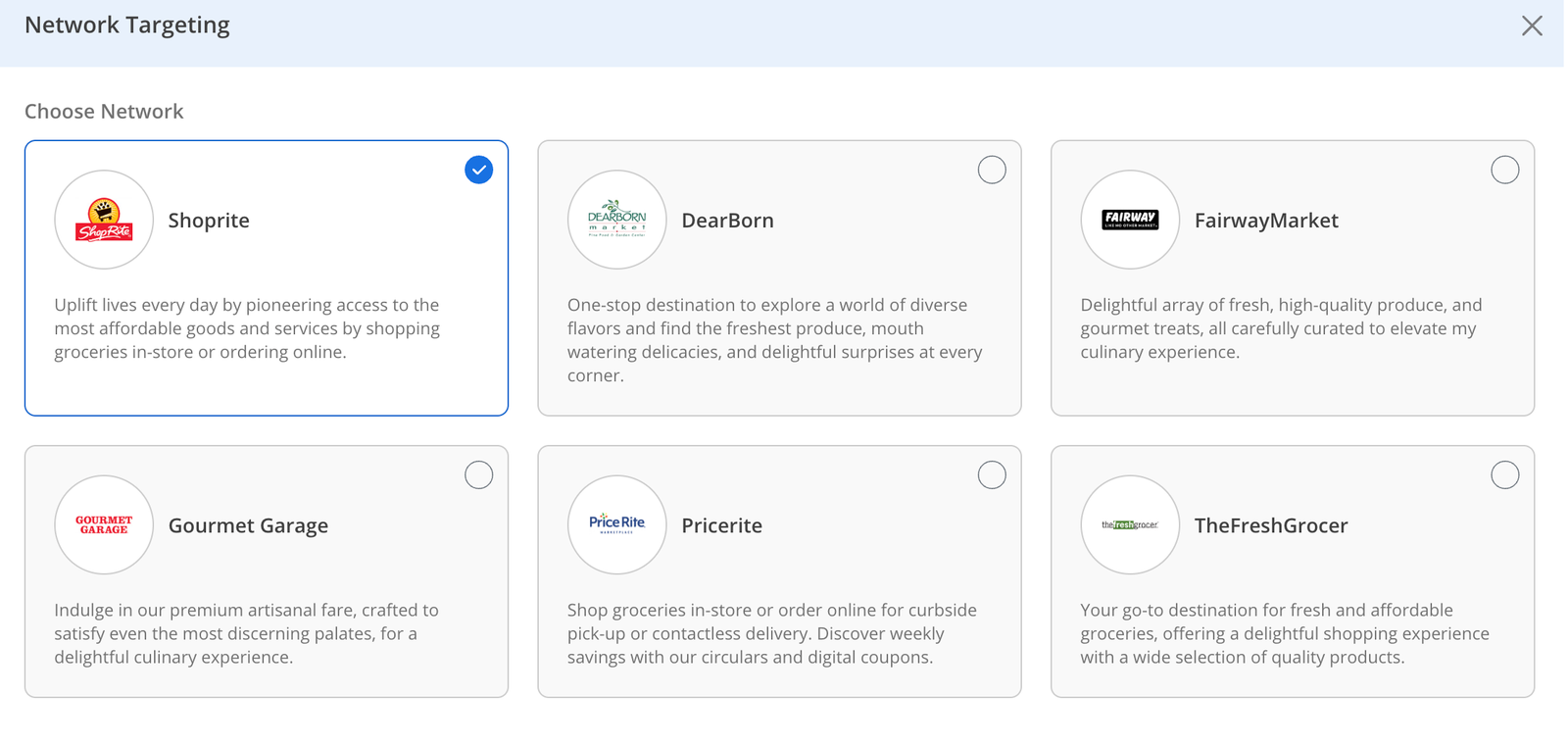
Six banners, selected one per campaign. If you are evaluating Inmar for onsite Sponsored Products, this is the inventory you are actually buying — and as section 4 explains, each banner is a separate campaign with its own budget and its own numbers.
The wider roster, and why it is hard to pin down
Beyond the platform, Inmar's aggregate claims do not agree with each other:
- "25 grocers... more than 40,000 retail locations" (March 2024, via Grocery Dive)
- "technology platform and services behind 30+ retail media networks globally" (July 2024)
- "240M+ Verified Shoppers" and "38% ACV Coverage Across the Total Grocery Market" (current)
- "30 million active loyalty shoppers" via the Digital Promotions Network (current)
- "200M+ targetable shoppers" and "98% identification across the U.S. population, with 80% household coverage" (current, brands page)
- Deterministic retailer data reaching "90% of U.S. households" (January 2025)
Those are six different denominators presented without definitions, spread across pages that never reconcile them. The most checkable is 38% ACV — ask Inmar specifically whether that measures coupon and incentive distribution coverage, which is likely, or media-addressable coverage, which would be much narrower.
Here is what can be independently confirmed — seven relationships, against a claimed 25 to 30.
| Retailer | Banners | What Inmar provides | Since |
|---|---|---|---|
| Wakefern Wakefern Media Exchange | ShopRite, Price Rite Marketplace, The Fresh Grocer, Dearborn Market, Gourmet Garage, Fairway Market — all six confirmed in the ad platform | Full network — onsite Sponsored Products and display, offsite, in-store; self-serve console | Mar 2024 |
| Northeast Grocery Shopper Link | Price Chopper / Market 32, Tops Friendly Markets (~300 stores) | Full network build — but see the warning below | Tops 2021, expanded Jul 2024 |
| Ahold Delhaize USA | Food Lion, Giant Food, The GIANT Company, Hannaford, Stop & Shop | Digital coupons (Jan 2025, displacing Neptune) and in-store advertising only (Mar 2025). ADUSA owns the network. | Jan 2025 |
| Costco | — | One of several shopper-marketing agencies for managed offsite. Inmar does not run Costco's network. | May 2025 |
| Smart & Final | 255 locations | Digital coupons and offsite media | Feb 2022 |
| bp | earnify app (convenience & gas) | Digital coupons, with Axonet — first programme of its kind in c-gas | Jan 2026 |
| RSA America | 250+ independent retailers | Exclusive digital coupon and settlement provider | Sep 2025 |
That last row is probably how "25 grocers" inflates: RSA America is a network-of-networks deal covering hundreds of independents, not hundreds of individual media relationships.
Inmar frequently does not own every advertising surface at a retailer it works with. Northeast Grocery launched Carrot Ads with Instacart in June 2023, putting Instacart in charge of onsite sponsored search and banner ads on Price Chopper and Tops. Thirteen months later the same retailer named Inmar for "Shopper Link." Neither announcement mentions the other, and Price Chopper still appears on Instacart's live Carrot Ads partner page.
So a brand buying "Price Chopper retail media" may need two vendors and will receive two sets of attribution that cannot be reconciled. Always ask which specific surfaces the Inmar seat covers at each specific retailer — onsite search, onsite display, offsite, CTV, in-store, offers — before you plan a budget.
One more caution. In March 2026 Inmar announced an API partnership with Eagle Eye, whose customer list includes Loblaws, Tesco, Carrefour, Asda and others. The release deliberately does not say which of those will activate Inmar offers. Do not read that list as a list of Inmar retailers. Similarly, Inmar's international retail media page names no international retailers at all, which makes the word "globally" in "30+ networks globally" difficult to substantiate.
3. What you can actually buy
Inmar Media's brand-facing lineup covers retailer media, digital media, DOOH, programmatic, connected TV, in-store, onsite, and a creator product. Display, paid social, CTV and DOOH are bought through Media Manager, its DSP, with ShopperSync as the underlying customer data platform. Targeting is sold on store-level granularity, SKU-level customer profiles, first-party audience creation, and MomentsAI, the contextual and behavioural engine inherited from Aki.
The incentives line is the heritage product and, realistically, the core: digital coupons delivered into retailer loyalty accounts and apps, retailer-agnostic cash-back offers, loyalty and rewards programmes, and promotion management and settlement.
Creator Hub handles influencer work with AI content verification and campaign matching, and a Commerce Fitscore that matches creators to audiences using transactional data. In May 2026 Inmar added multi-retailer creator activation — the first move toward buying across networks in a single campaign that I have been able to find documented, and so far creator-only.
Inmar does not market a classic auction-based sponsored products search product under its own name anywhere on its public site, and its onsite media page is not publicly accessible. That absence is misleading. The product exists, I run it, and the next section describes what it actually looks like — because as far as I can tell, nobody else has published this.
4. What the platform actually looks like
Everything below comes from running live Sponsored Products campaigns on an Inmar-powered network. None of it appears in Inmar's public documentation, which is why I am writing it down.
The console
The interface is organised around two campaign families: Sponsored Product Ads and Display Ads, with Finance, Activity Center and Help Center alongside them. It is a genuine self-serve console — you build, launch and optimise campaigns yourself. This is not a managed-service-only relationship dressed up with a reporting login.
Network targeting: one banner per campaign
Campaigns are targeted to a single network at a time, chosen from the banners in the retailer group. On the Wakefern side that means ShopRite, Dearborn Market, Fairway Market, Gourmet Garage, Price Rite and The Fresh Grocer as separate selections rather than a combined buy.
This has a direct planning consequence. Budget, keywords and reporting live at banner level, so covering several banners means several campaigns to build and several sets of numbers to reconcile. It also confirms the Wakefern banner list independently of anything Inmar publishes.
Two campaign types
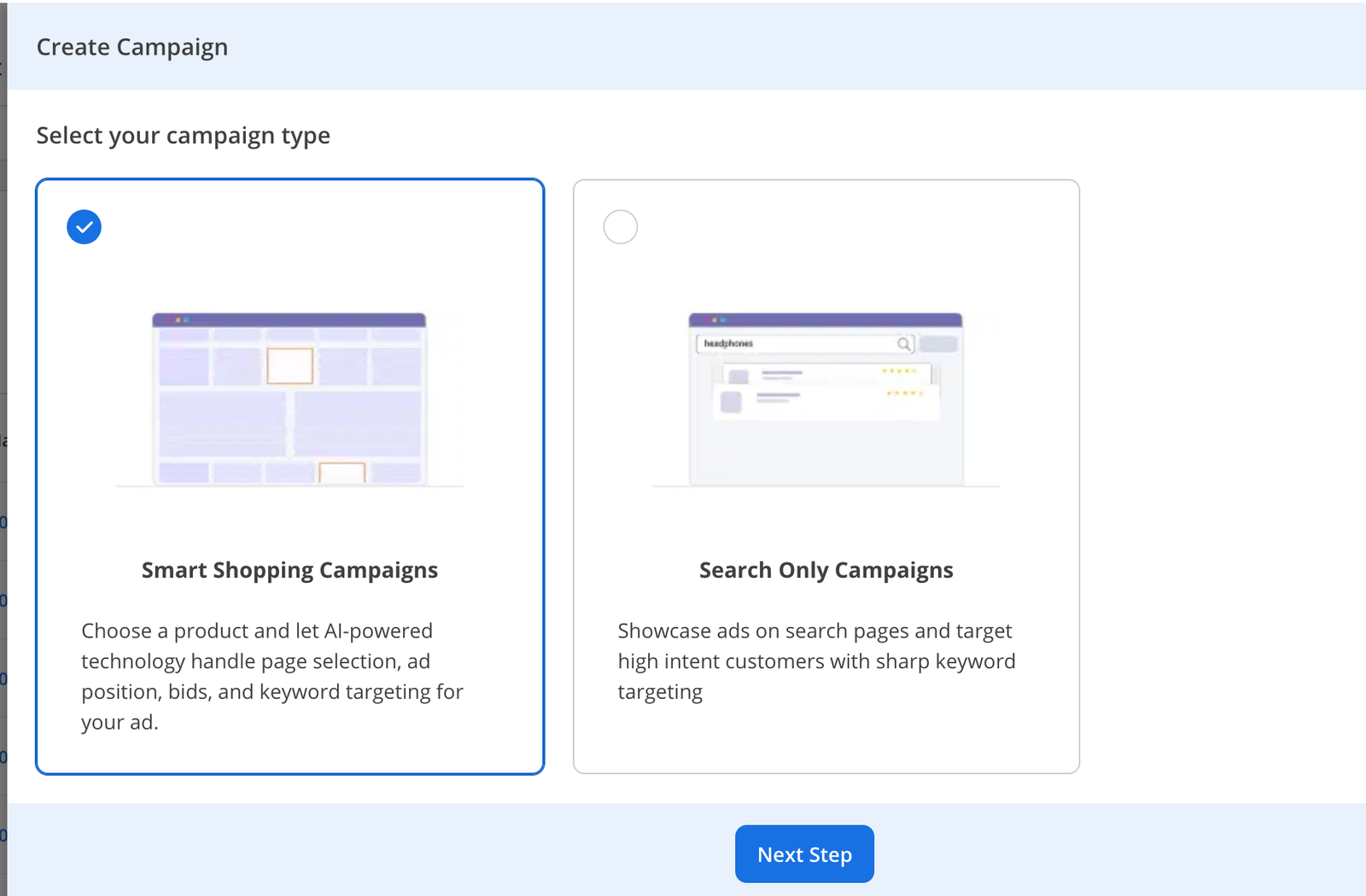
Smart Shopping Campaigns let the platform handle page selection, ad position, bids and keyword targeting for a chosen product. Search Only Campaigns place ads on search pages against keywords you control. So there is an auction-based search product, and the two types behave very differently — the first is a black box, the second is the one you can actually steer.
Smart Mode and Manual Mode
Beneath campaign type sits a second, blunter switch. Smart Mode is described as the AI doing all the work with 24/7 monitoring and automatic strategies. Manual Mode is described, in the platform's own words, as "you do all the work," with the warning that you have to constantly monitor products yourself.
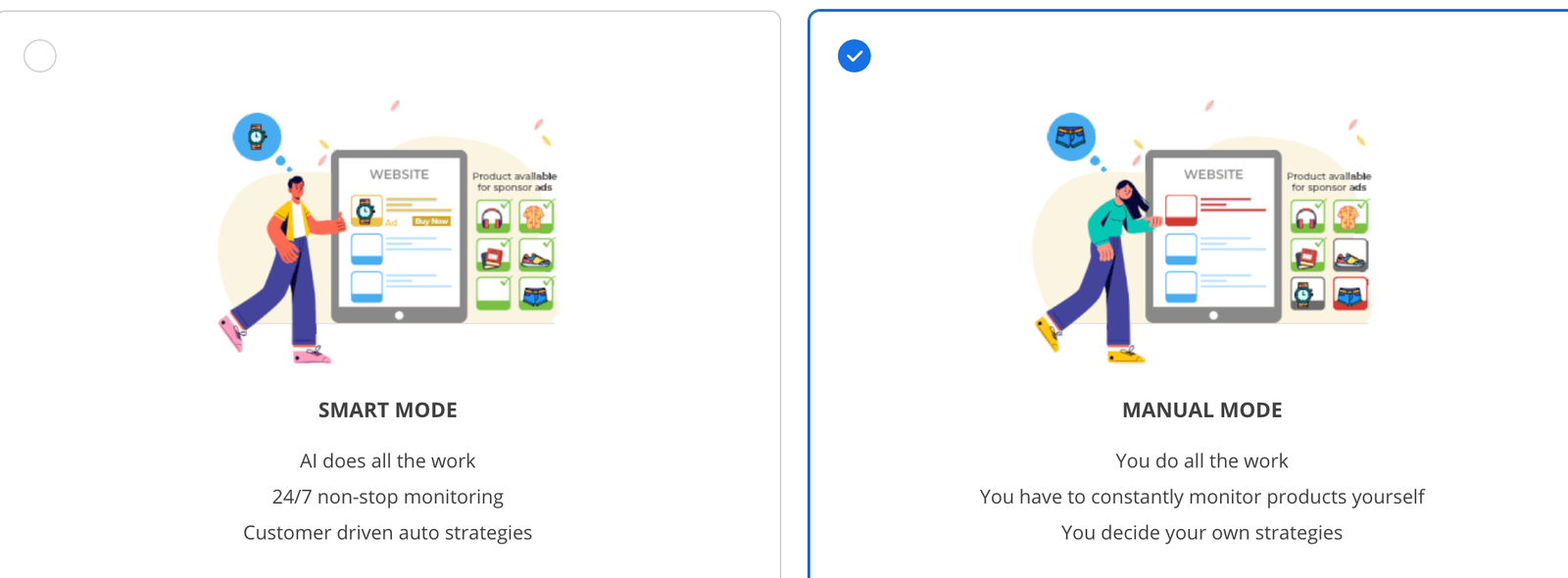
The framing pushes hard toward automation, and Smart Keyword Targeting carries a "Recommended" badge. For an account where you care about which terms you are buying, Manual is the one that gives you control — with the important caveat below.
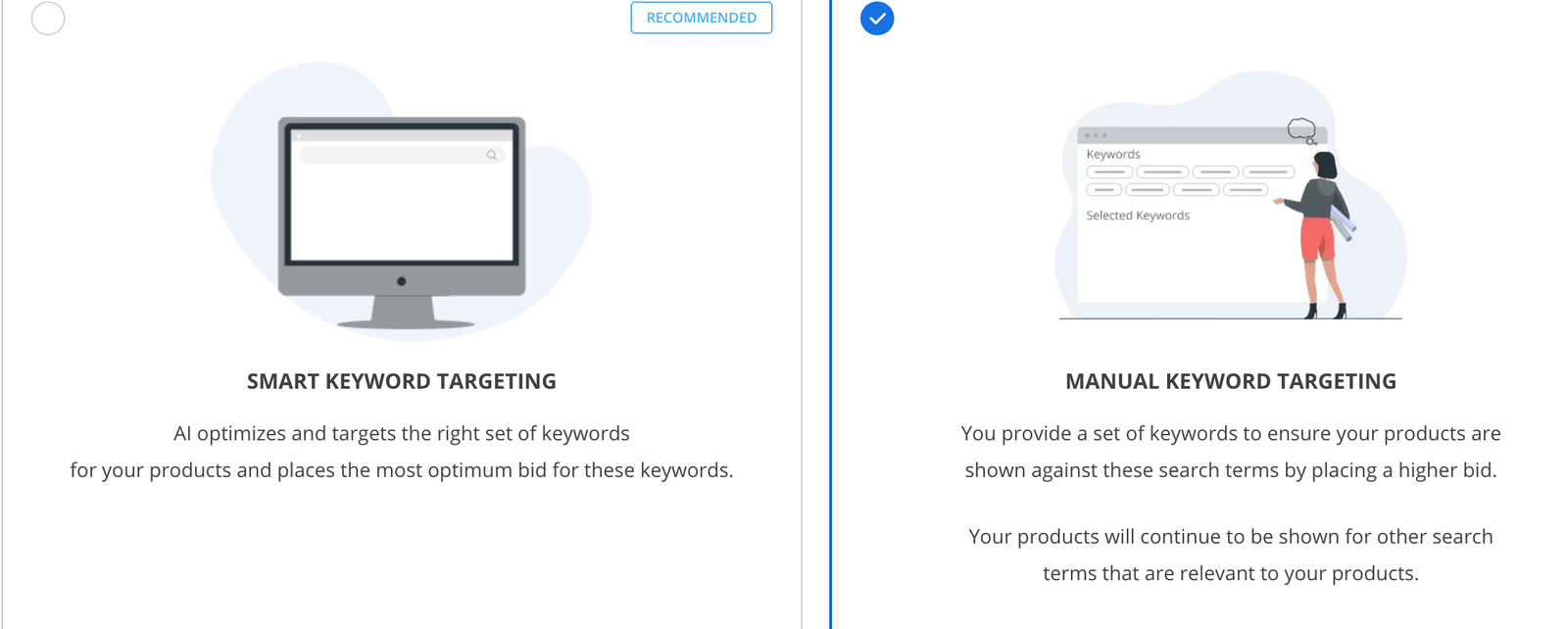
Manual keyword targeting is not exclusive. The platform states it plainly: you provide keywords to ensure your products show against those search terms by placing a higher bid, and "your products will continue to be shown for other search terms that are relevant to your products."
Read that again if you come from Amazon. Your keyword list is a bid emphasis, not a boundary. There is no exact-match containment in the sense an Amazon or Walmart advertiser would expect, and I have found no negative keyword tool to fence off the rest. Budget will reach queries you did not choose. Plan structure, and read search-term performance, on that basis rather than assuming your list is the whole story.
Product selection, and why campaigns split by brand
Products are added by filter, individually, or in bulk upload, with an explicit include/exclude distinction. The product table exposes name, brand, category, availability, price and sale price — and brand is a first-class field.
That is the practical reason to structure campaigns by brand rather than by category or objective: it maps to how the platform selects products, keeps reporting legible, and stops one brand's budget being spent on another's SKUs within a shared house portfolio.
Availability sitting in that table matters too. On a grocery network with variable in-stock rates by banner, an out-of-stock SKU inside a live campaign is wasted budget, and the platform surfaces the data to catch it.
Budget pacing
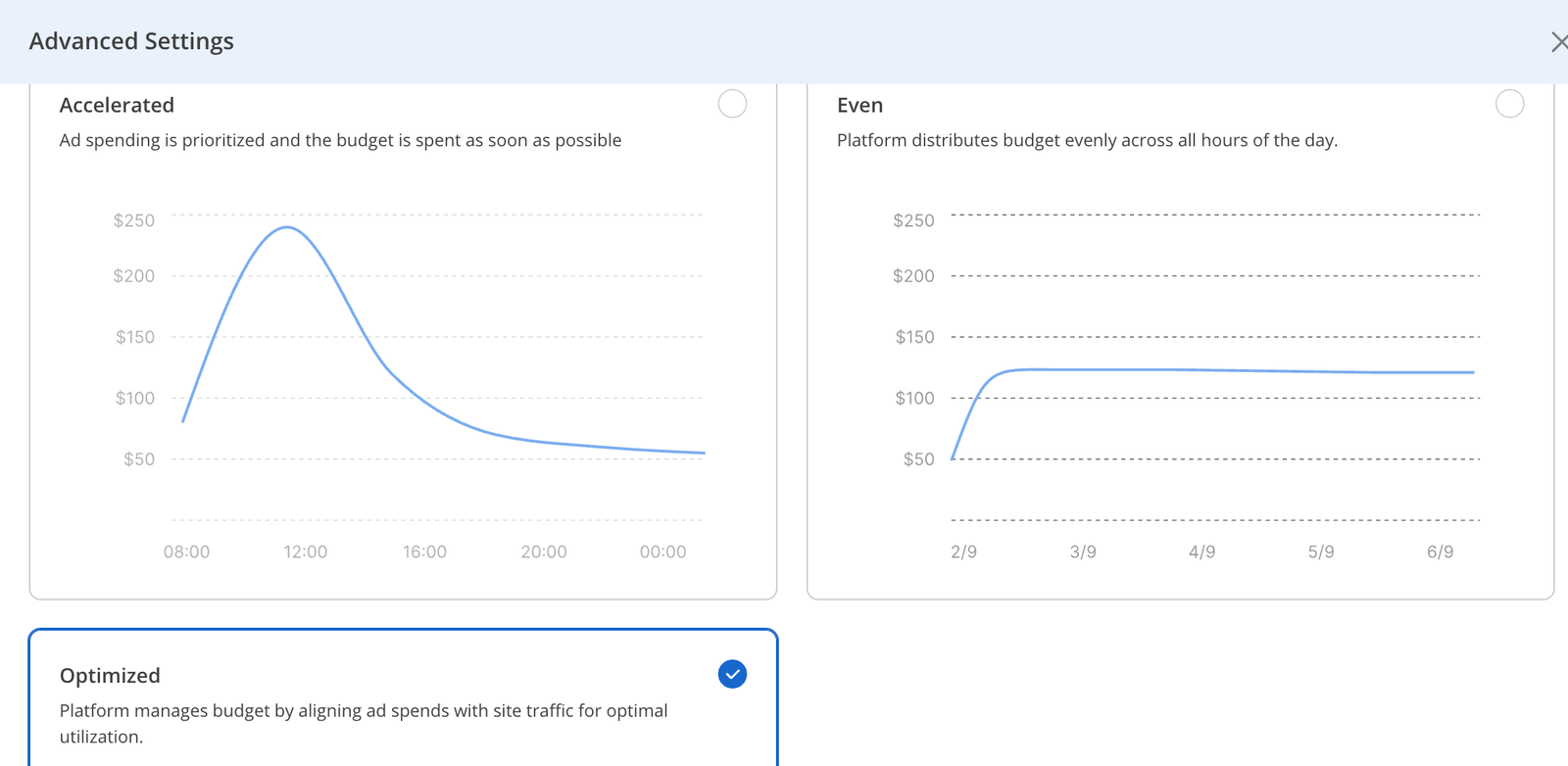
Three options: Accelerated spends the budget as soon as possible; Even distributes it evenly across all hours; Optimized aligns spend with site traffic. I normally start on Optimized for steady-state grocery, because shopping is heavily time-of-day skewed and letting the platform follow traffic beats guessing. Accelerated earns its place in short promotional windows — which, given Inmar's offer-driven heritage, is where a lot of grocery activity sits anyway.
Billing runs on a prepaid wallet
This one catches people out. The account carries a funded balance that campaigns draw down, rather than being invoiced in arrears. If the wallet empties, delivery stops.
Build the top-up into your monthly routine, and watch it before any promotional period. A brand used to net-30 invoicing on other retail media platforms needs to plan cash differently here.
What the reporting gives you
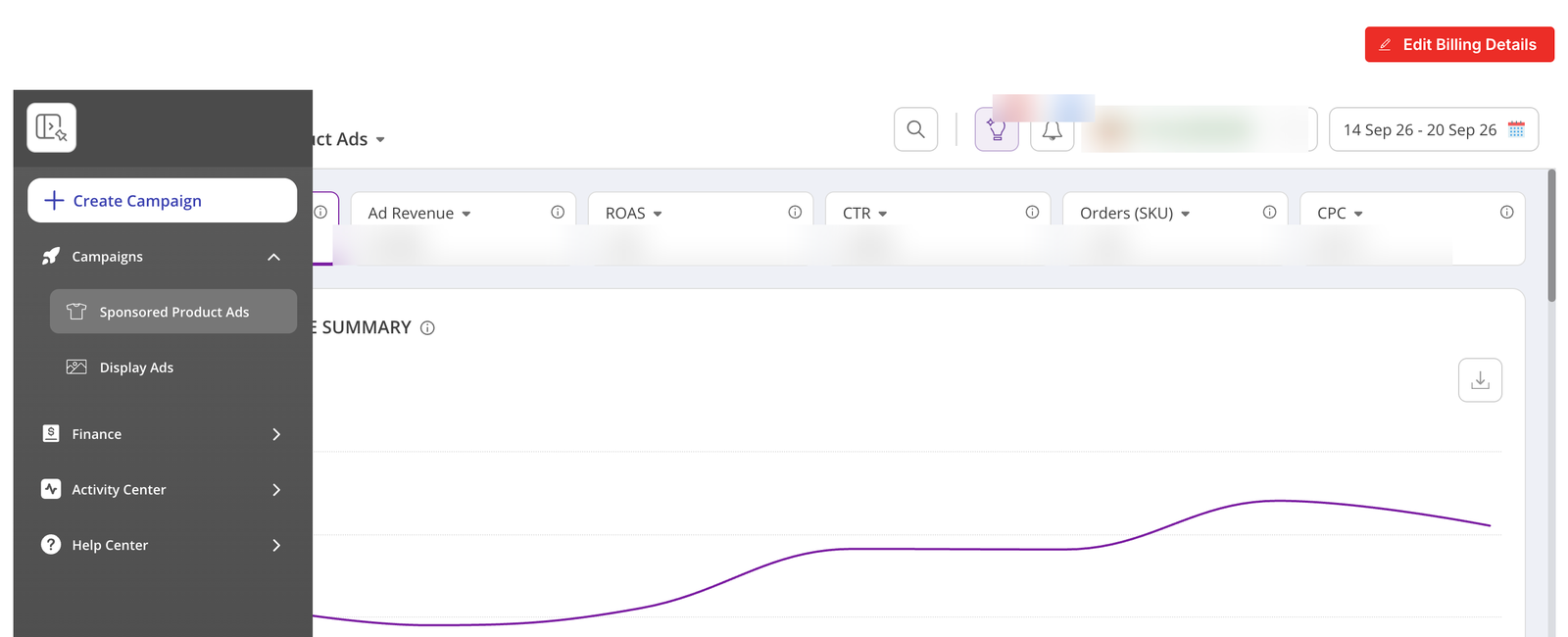
The dashboard reports ad revenue, ROAS, CTR, orders at SKU level and CPC, over a selectable date range, with a performance summary chart and an export. SKU-level order reporting is genuinely useful and better than the public documentation would lead you to expect.
What it does not give you is the thing Inmar declines to publish anywhere: a stated attribution window, a view-through versus click-through policy, or an incrementality methodology. You get the outputs without the definitions. Treat the ROAS figure as directional and internally consistent rather than as something you can compare across platforms — a ROAS here and a ROAS on Amazon are not measuring the same thing until someone tells you the windows match.
5. How you buy it — and what it costs
Both managed service and self-service exist, but they are exposed through the retailer rather than through Inmar. Wakefern and Northeast Grocery both offer each. The self-serve described publicly is narrow: launch offsite media campaigns, pull from offer details, auto-generate creative, with a "minimised need for media buying expertise." That is offer-driven offsite, not a full-funnel console.
There is no public self-signup. Every brand-facing page on Inmar's site terminates in "Book A Meeting."
For the self-serve ad platform: nothing is published
No minimum spend, no CPC rate card, no take rate, no management fee, no contract length. The coupon settlement guide, the natural place for fee disclosure, discloses no fees at all. What I can say from running it is that budgets are set at campaign level and drawn from a prepaid wallet, so the practical floor is whatever the retailer will open an account for rather than a published tier.
Inmar sells both the self-serve auction platform described above and a managed shopper marketing operation — circular features, promotional programmes, white-glove account teams. Different products, different buying routes, very different entry costs. Costco, for instance, uses Inmar as one of several shopper-marketing agencies for managed offsite work rather than as its network operator.
Most confusion about what Inmar costs comes from quotes for one being read as pricing for the other. Establish which one you are being sold before you compare anything.
Managed programmes carry gates that budget cannot open
Managed promotional programmes are typically tied to a retailer's weekly circular, which brings requirements the auction platform does not have: minimum distribution thresholds across the chain, a hero item matching the promotion, and creative rules that can prohibit brand logos, recipes or competitive comparisons.
Ask about distribution gating before you ask about price. A brand in regional distribution can be structurally ineligible for a managed programme regardless of what it is willing to spend — and that has nothing to do with the self-serve platform, where the constraint is simply what the retailer will open an account for.
6. Measurement: strong claims, thin disclosure
Inmar markets closed-loop measurement that "connects media exposure to verified store visits and transaction outcomes," measuring incremental lift and iROAS, with real-time sales attribution dashboards and auto-optimisation down to SKU level. On managed programmes it commits to a post-analysis report at the end of every campaign.
What is not disclosed anywhere public: the attribution model itself. No lookback window. No view-through versus click-through policy. No incrementality methodology — holdout, synthetic control, matched market, unstated. No new-to-brand definition. No evidence of third-party verification; every indication is that measurement is self-attributed.
Two things are worth holding side by side here. Inmar's own "Retail Media Confessions" series concedes the industry's transparency problems, covering attribution windows and cross-network measurement — though it is a video series, not research, and carries no survey data or sample sizes. Meanwhile Rachel Tipograph of MikMak, talking to Grocery Dive about regional grocers generally, said that "for nearly all of them none of that data is in real time. And digital media is a real-time game." That sits directly against Inmar's real-time claims. Test it with a live campaign before you believe either side.
7. Inmar versus the alternatives
| Inmar | Instacart Carrot Ads | Criteo | |
|---|---|---|---|
| Core model | White-label tech plus managed services plus coupon clearing and settlement | White-label ad tech plus pooled CPG demand | White-label tech plus demand, DSP and API network |
| Brings its own demand? | Not demonstrated publicly | Yes — states 9,000+ CPG brands | Yes — thousands of brands and hundreds of agencies |
| Unique asset | Coupon and offer settlement, plus 45 years of CPG-retailer relationships | Marketplace shoppers, fulfilment, Caper smart carts | Scale, API and DSP openness, SKU-level reporting |
| Cross-retailer buying | No evidence outside creator campaigns | Centralised through Instacart Ads | Centralised via platform, API or DSP |
| Strongest at | Offers, incentives, in-store | Onsite e-commerce search and display | Onsite retail media at scale |
| Weakest at | Onsite search; publicly undocumented | In-store and offer mechanics | Offer and promotion integration |
The honest summary: Inmar is a supply-side enabler plus a services layer, strongest at the offer and in-store ends of the value chain and weakest at onsite e-commerce search. Functionally it sits closer to a shopper-marketing agency with proprietary technology than to a pure ad-tech platform — which is precisely how Costco uses it.
For a small brand, the decisive question is aggregation. Instacart and Criteo both advertise pooled cross-retailer demand and centralised buying. Inmar's May 2026 multi-retailer creator product is the first publicly documented move that way, and it is creator-only. For ordinary display and offer media there is no public evidence of a single Inmar buy spanning multiple retailers' networks — which means retailer-by-retailer buying, with separate minimums and separate reports for each — a real cost to factor into cross-retailer planning and budget allocation.
8. Is Inmar right for you?
It is a reasonable fit if your brand is stocked in one of the confirmed networks above, promotions and coupons are already part of how you sell, you have distribution deep enough to clear the retailer's threshold, and you want in-store and offer mechanics that Instacart and Criteo do not really offer.
It is probably the wrong platform if onsite search is your main lever, if you need one buy across several retailers, if you have no promotional strategy to build offers from, or if you need transparent, verifiable attribution to justify spend internally.
Grocery Dive's reporting on regional grocers puts the competitive reality plainly. Melissa Burdick of Pacvue noted that brands already using CitrusAd and Criteo have limited incentive to work with smaller platforms, and said that "the current playbook of retail media is not effective for" regional grocers operating independently. Instacart was described as "typically the path of least resistance." Inmar's own Rob Weisberg conceded the underlying problem: "In the media space, it's about how many impressions can you deliver?"
In fairness, there is counter-evidence on small-brand access. Inmar acquired Reach Influence in 2017 explicitly to help emerging brands compete; Northeast Grocery's Diane Colgan said the network "empowers brands of all scales"; and in February 2026 Inmar partnered with GS1 US specifically to help emerging brands get UPC and coupon setup right. Worth noting, though, that both small-brand initiatives concern data hygiene rather than media access — and that every named client on Creator Hub is an enterprise CPG.
9. What to ask before you sign
Bring this list to the first call. The answers will tell you more than any deck, and the same questions are worth asking of any network you are already running — which is where a retail media audit usually starts.
- The full retailer list — and for each one, which surfaces Inmar controls versus another vendor. This is the highest-value question in the entire conversation.
- Minimum spend at my target retailers, in writing, and separately for the self-serve platform versus any managed programme.
- The fee structure — platform fee, managed-service percentage, data fee, creative fee, and whether ad-serving margin is disclosed. AdExchanger reports brands typically pay retailers an additional 10–30% in management fees on offsite media; that is an industry benchmark, not an Inmar rate, but it is a reasonable anchor.
- A reference brand under $50M revenue. If none exists, that is your answer about small-brand fit.
- Is there distribution gating — a minimum share of stores carrying the SKU — at this retailer, and does it apply to the auction platform or only to managed programmes?
- Can I buy across retailers in one campaign, or is it one buy per network?
- Is there auction-based onsite sponsored products at this retailer? It exists on the networks I run, but capability varies, so ask for a live demo rather than a slide. While you are in the demo, confirm whether manual keyword targeting is exclusive and whether negative keywords exist — on the networks I use, the answer to both is no.
- The attribution model in writing — lookback window, view- versus click-through, incrementality method, new-to-brand definition, any third-party verification.
- A sample report before signing, and whether log-level data is available.
- Is there a clean room or data collaboration option? I could find no evidence of one, while Criteo, Instacart and major retailer-owned networks all offer something here.
- What does 38% ACV actually measure — incentive distribution coverage, or media-addressable coverage?
- Who owns my account, and contract length, cancellation terms and make-goods.
We run retail media on the platforms most agencies skip
Inmar, DoorDash Ads, Loblaws Advance, Instacart, Walmart Connect, Kroger, Target and Amazon — managed for CPG brands that need someone who has actually used the platform, not just read the deck.
Book a discovery callFrequently asked questions
Can I sign up for Inmar directly?
No. There is no public self-signup for advertisers. Every brand-facing page on Inmar's site ends in a "Book A Meeting" form, and in practice you buy through the individual retailer whose network Inmar powers. Managed programmes often route you to the retailer's own shopper marketing team rather than to Inmar at all.
Is Inmar the same as Aki Technologies?
Effectively yes, historically. Inmar named its consolidated media division Aki Technologies in April 2023, then retired that name in January 2025 and reintroduced the offering as Inmar Media. Older case studies and coverage may sit under either name, which makes research harder than it should be.
What does advertising on Inmar cost?
It depends entirely on which Inmar you mean. For the self-serve ad platform — Sponsored Products and display — nothing is published. Budgets are set per campaign and drawn from a prepaid wallet, so there is no published minimum tier.
For managed shopper marketing programmes, pricing is negotiated per retailer and per programme, and runs materially higher because it is a serviced product tied to circular placement. Get quotes for the two separately; they are not comparable.
Does Inmar have sponsored products like Amazon or Walmart?
Yes, though Inmar documents none of it publicly. There is a self-serve console with Sponsored Product Ads and Display Ads, offering Smart Shopping campaigns where the platform controls placement and bidding, and Search Only campaigns targeted against keywords you supply.
One critical difference from Amazon and Walmart: manual keyword targeting is not exclusive. The platform states that your products "will continue to be shown for other search terms that are relevant," so your keyword list functions as a bid emphasis rather than a boundary. Onsite capability also varies by retailer, so verify it for the specific network you care about.
Which retailers can I reach through Inmar?
Inmar claims 25 to 30 networks but has never published the list. Independently confirmed: Wakefern (ShopRite, Price Rite, The Fresh Grocer, Fairway and others), Northeast Grocery (Price Chopper/Market 32, Tops), Ahold Delhaize USA for coupons and in-store only, Smart & Final, bp, RSA America's independent retailers, and Costco on a managed agency basis. Ask for the complete list, and for which surfaces Inmar controls at each.
Inmar or Instacart — which should a small brand choose?
They are often not alternatives but layers at the same retailer. Instacart is generally stronger for onsite e-commerce search and display and allows centralised cross-retailer buying; Inmar is stronger on offers, incentives and in-store, and is bought retailer by retailer. At a retailer like Price Chopper you may encounter both. Start by establishing who owns which surface, then decide where your budget does most work.
Sources
Where a claim comes from Inmar's own marketing it is attributed as such. Figures are current as of publication.
- Inmar, FAQ — company history and founding.
- Inmar, Media for Brands — product lineup and closed-loop measurement claims.
- Inmar, Digital Media — targeting and platform detail.
- Inmar, Incentives for Brands — 240M+ verified shoppers and 38% ACV.
- Inmar, Martech for Brands — 200M+ targetable shoppers, 98% population identification, 80% household coverage.
- Inmar, Multi-Retailer Creator Activation — cross-retailer creator product and retailer-level measurement.
- Inmar, What is coupon settlement — publisher and settlement provider positioning.
- Inmar, Inmar Media launch — 23 January 2025.
- Inmar, Northeast Grocery partnership — 23 July 2024.
- Inmar, RSA America — 23 September 2025.
- Grocery Dive, Wakefern launches retail media network — March 2024, Offer Media and the 25-grocer claim.
- Grocery Dive, Northeast Grocery and Instacart Carrot Ads — 20 June 2023.
- Grocery Dive, What it takes for regional grocers to maximize retail media — Burdick, Tipograph and Weisberg quotes.
- ADUSA, AD Retail Media in-store partnership — 11 March 2025.
- P2PI, Costco partnership detail — 28 May 2025.
- P2PI, Inmar names its media division Aki Technologies — 18 April 2023.
- PR Newswire, Eagle Eye partnership — 23 March 2026.
- PR Newswire, GS1 US partnership for emerging brands — 25 February 2026.
- Instacart, Carrot Ads partners.
- Criteo, Retail media for retailers.
- AdExchanger, Retail media's growing pains — 23 June 2025, the 10–30% management fee benchmark.
- OMERS Private Equity, Acquisition of Inmar — 4 April 2017.